Norway's modeled sea lice pressure for the first eight months of 2026 sits at 419 million, the lowest January-through-August total since 2020. Eight of Norway's thirteen production areas, together accounting for roughly 83 percent of national volume, show the same decline independently.
Manolin's pressure figure estimates the total lice pressure building across the coastline, combining reported weekly lice counts with the number of active net pens in production.
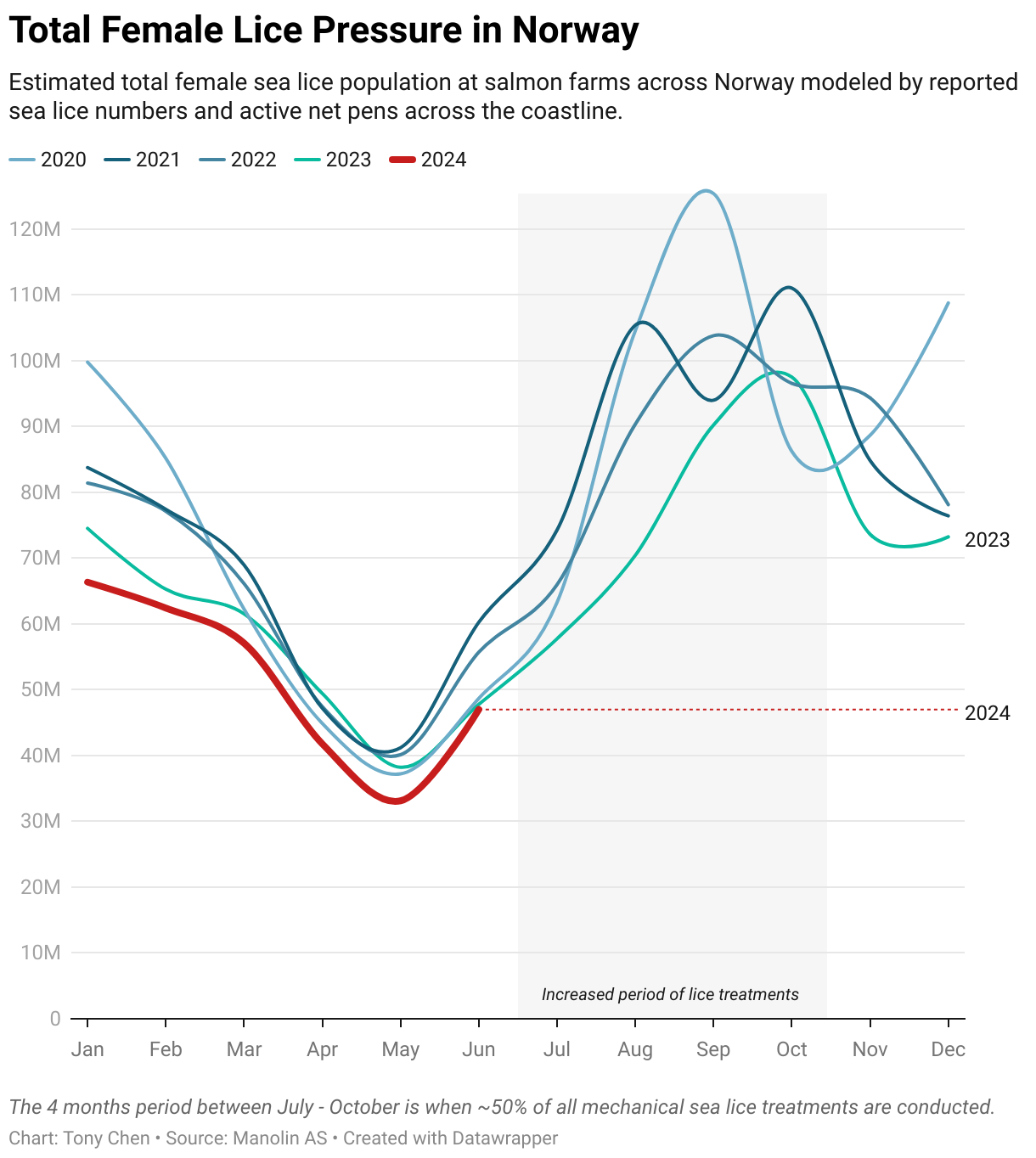
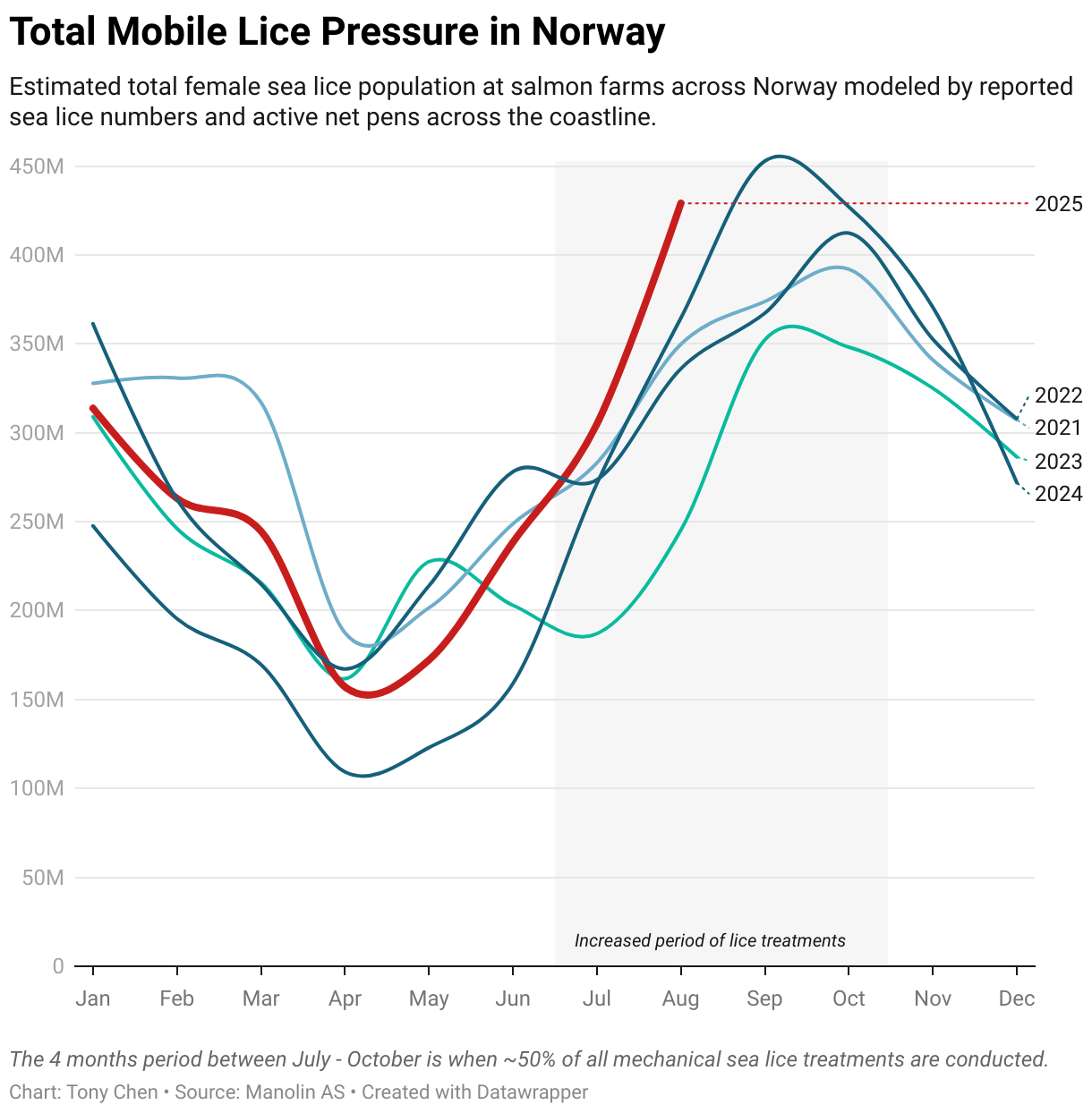
A Decline That Spans the Coast
July and August 2026 came in 30 to 55 percent below the same two months in both 2024 and 2025 across Ryfylke (PO2), Karmøy to Sotra (PO3), Nordhordland to Stad (PO4), Stad to Hustadvika (PO5), Nordmøre and Sør-Trøndelag (PO6), Nord-Trøndelag with Bindal (PO7), Helgeland to Bodø (PO8), and Andøya to Senja (PO10).
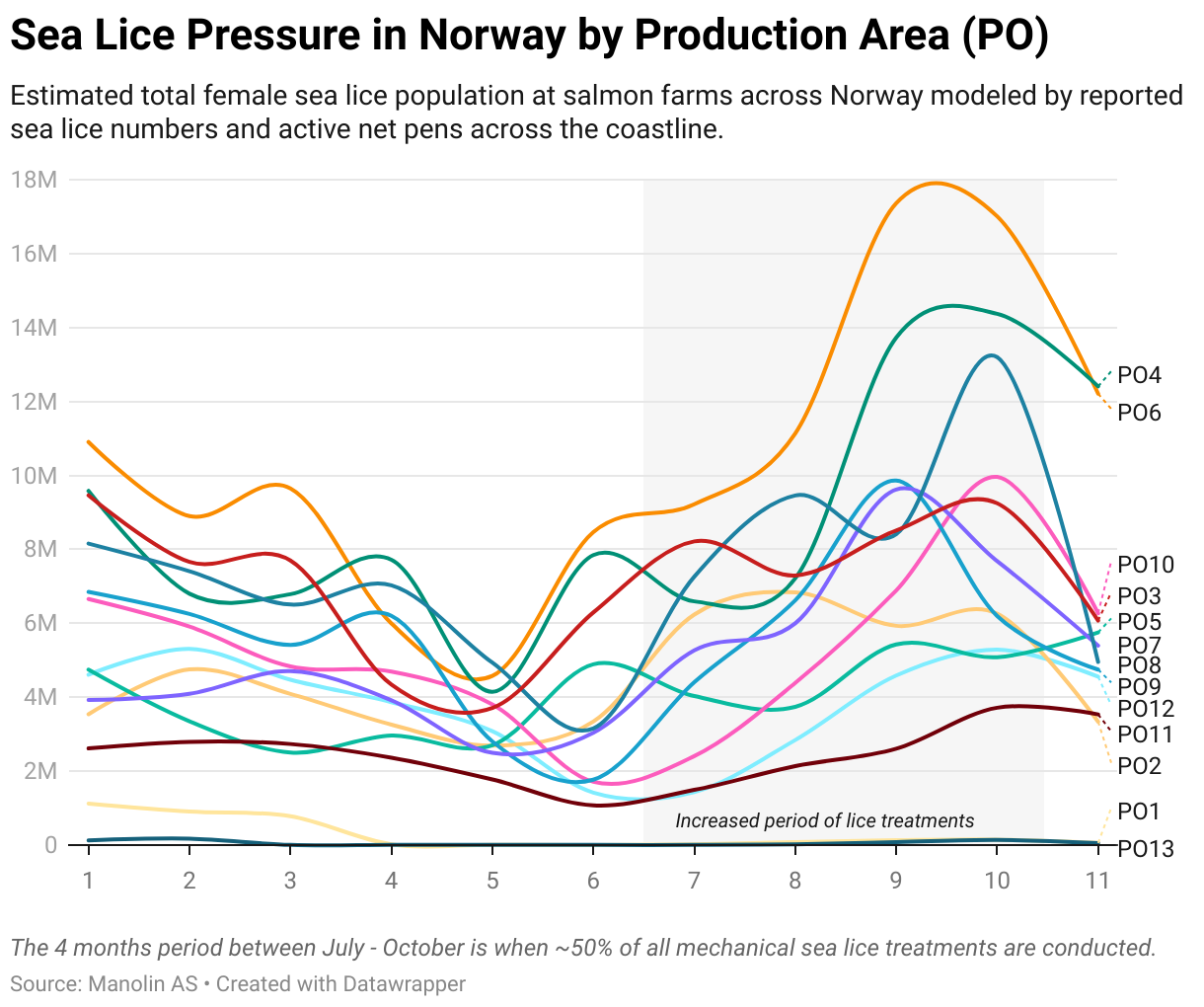
Nordmøre and Sør-Trøndelag (PO6), the largest single production area by lice pressure, shows the swing clearly. It hit its highest monthly value on record in October 2025, at 33 million, then ran roughly 24 million for July and August 2026 combined, down about half from the same two months a year earlier. Three of PO6's five highest months on record fall in the second half of 2025.
2025 was the highest year in Manolin's five full annual records by a wide margin, and outside reporting backs that up. Mattilsynet issued a formal warning about a "concerning increase" in sea lice following the summer of 2025, citing elevated sea temperatures, and the Norwegian Veterinary Institute's 2025 Fiskehelserapport recorded a record number of lice treatments industry-wide that year, tied to the same warm water. 2026 follows directly from that 2025 peak, so part of the drop is likely reversion from an unusually high year rather than a permanent shift lower.
A Cooler July and August
2026 didn't start mild. January through June ran warm, at or near the five-year high for most months. July and August then reversed sharply, coming in as the coldest reading for those two months across the entire five-year temperature record, cooler even than 2023's mild season.

Sea lice development speeds up with water temperature. Havforskningsinstituttet describes the mechanism directly, citing peer-reviewed research (Skern-Mauritzen et al., 2020): warmer water shortens the time lice take to mature and increases how effectively they attach to a host fish. A warm spring followed by a cool July and August is a specific explanation for a quieter summer buildup, distinct from a uniformly cold year. It also runs in the same direction as what HI documented during the marine heatwave that hit northern Troms and western Finnmark in 2024, when unusually high sea temperatures were tied directly to a sharp jump in lice production in that region.
Treatment Hasn't Eased With Sea Lice Pressure
If temperature explained the full decline, treatment activity would have eased along with the falling pressure. It hasn't: mechanical treatment counts for January through August 2026 ran at 4.99 treatments per million in modeled pressure, the highest ratio in five years and above even 2025's outbreak season, at 4.20.
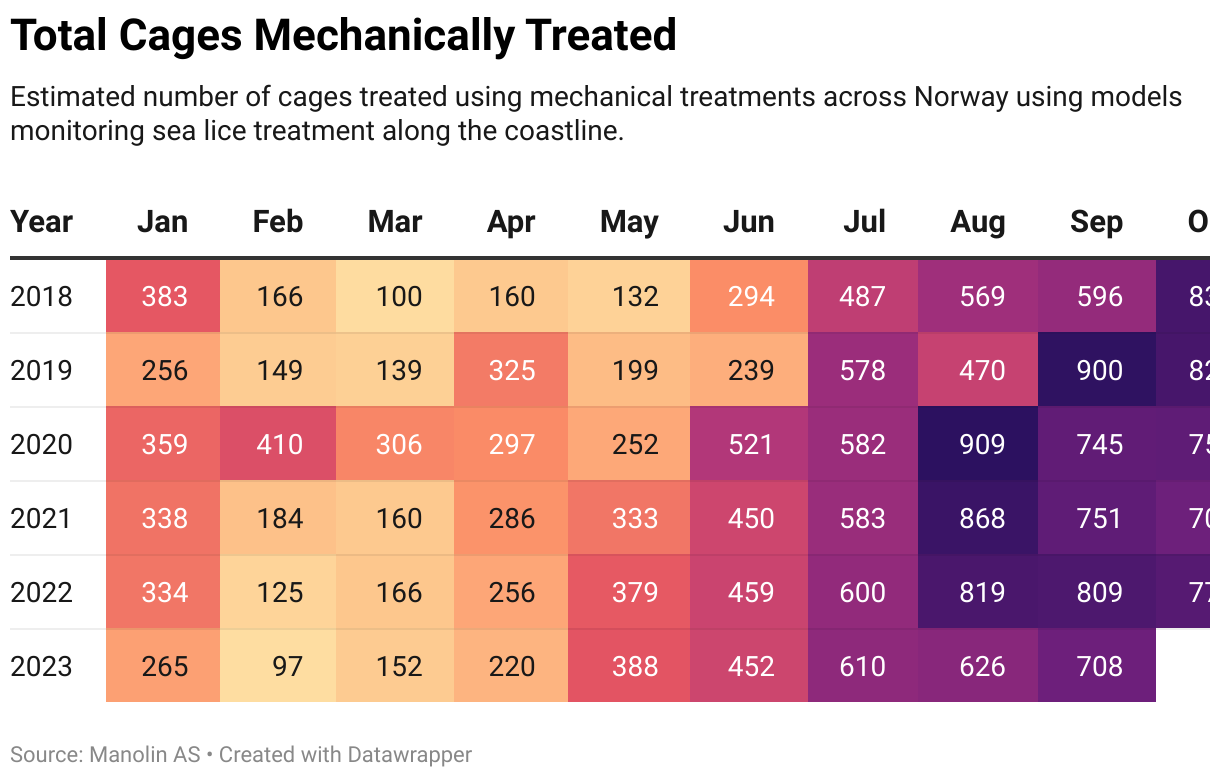
Roughly half of all mechanical treatments in Norway happen between July and October. Producers treating at a record rate relative to falling pressure, heading into that window, points to a preventive posture rather than pressure declining purely on its own. The lower pressure figure for 2026 reflects both a cooler summer and continued heavy treatment, and the data doesn't separate how much each is contributing.