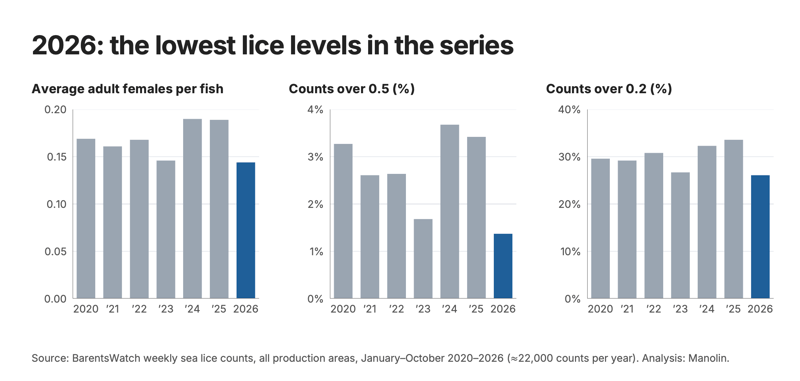
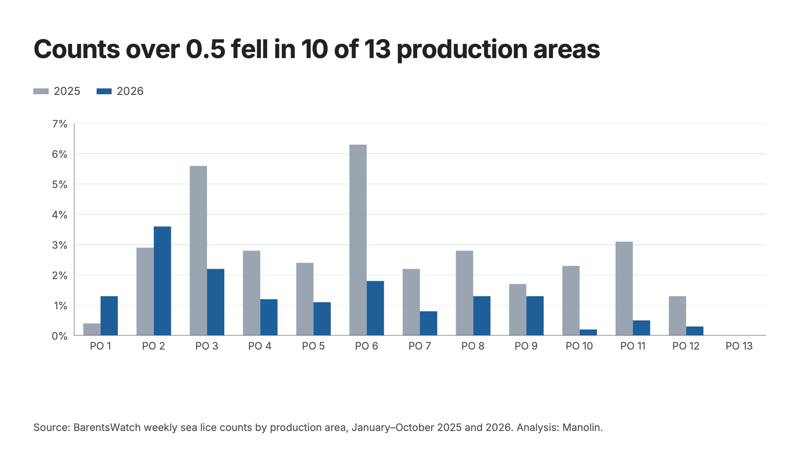
2026 was the lowest sea lice year (according to BarentsWatch data) since 2020. From January to October, Norwegian farms averaged 0.14 adult female lice per fish. Only 1.4% of weekly counts went above 0.5, and counts over 0.5 fell in 10 of the 13 production areas.
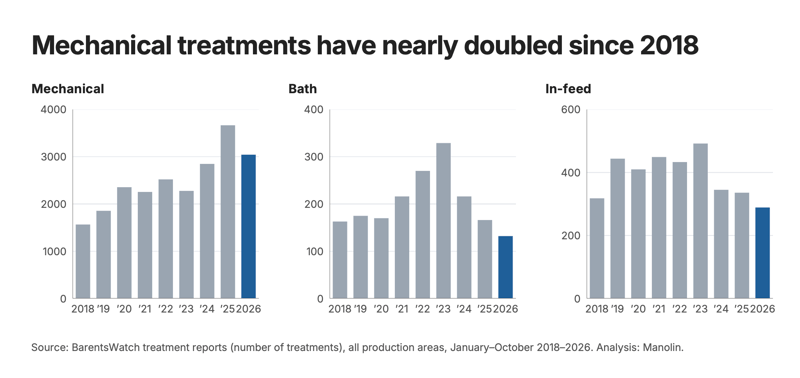
Those numbers are a success that took a lot of work from farm managers across Norway. Farms carried out about 3,000 mechanical treatments in the first ten months of the year, close to double the 2018 level. By Manolin's model, the industry treated about 29% more than the season's temperatures would predict. Teams kept treatment intensity high through a year when lice levels were low.
We also see in our data that the weather created a more positive year. Sea temperatures from July to September averaged 12.7 °C, a full degree cooler than 2025. Manolin's fall lice pressure model links warmer falls to more lice, and it put 2026 almost exactly where expected: 82 million adult female lice in the sea from August to October, against 83 million predicted.
That raises the question for next season. If the fall runs as warm as 2024, the same model points to around 126 million adult female lice, 54% more than this year. Planning for that now, while lice levels are low, can help this year's progress carry into a warmer year.
How the 2026 Sea Lice Season Compares
Across the three lice measures we track each season (average adult females per fish, the share of counts above 0.5 and the share above 0.2), 2026 came in lowest on all of them. The average of 0.14 adult females per fish narrowly edged out 2023 and sat well below the 0.19 recorded in both 2024 and 2025. Counts above 0.2 dropped to 26% of the total, down from 34% last year.
The biggest shift came in the share of counts above 0.5, which fell to 1.4% from 3.4% in 2025 and 3.7% in 2024. Far fewer counts came close to the 0.5 limit that applies for most of the year.
Between 2025 and 2026, the share of counts over 0.5 fell in 10 of Norway's 13 production areas, with some of the largest drops in western and central Norway. PO 6 went from 6.3% to 1.8% and PO 3 from 5.6% to 2.2%, while further north PO 10 and PO 11 both fell below 1%. PO 1 and PO 2 in the south saw small increases, and PO 13 recorded almost no lice in either year.
Farms Put in the Work
The low lice counts in 2026 had a lot of treatment work behind them, with farms carrying out 3,043 mechanical treatments from January to October. That is nearly double the 1,567 over the same months in 2018, and while it came in below the 2025 peak of 3,667, it was still the second-highest total since 2018.
Bath and in-feed treatments moved in the opposite direction, both peaking in 2023 before falling to 132 and 289 in 2026, the lowest totals for either since 2018. Close to nine in ten treatments in 2025 and 2026 were mechanical, compared with about three in four in 2018.
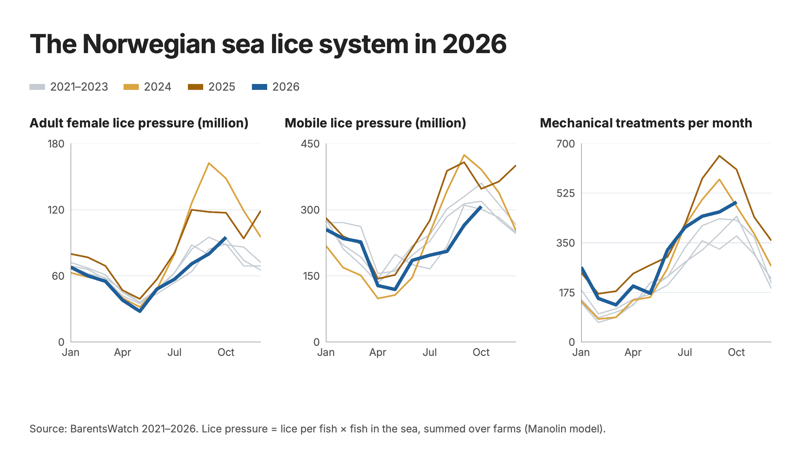
We measure lice pressure as the total number of lice in the sea, calculated as lice per fish multiplied by the number of fish and summed across all farms. From August to October, adult female lice pressure in 2026 tracked close to the 2021–2023 seasons and well below the highs of 2024 and 2025. Over the same months, mechanical treatments ran above 2021–2023 levels every month and reached 493 in October.
How Temperature Comes Into Play
A lice season is hard to judge without understanding how warm the water was over the year. Lice develop faster in warmer water, and we see that play out in our data, where warmer falls bring more lice pressure. As a result, the same management can produce very different counts from one year to the next.
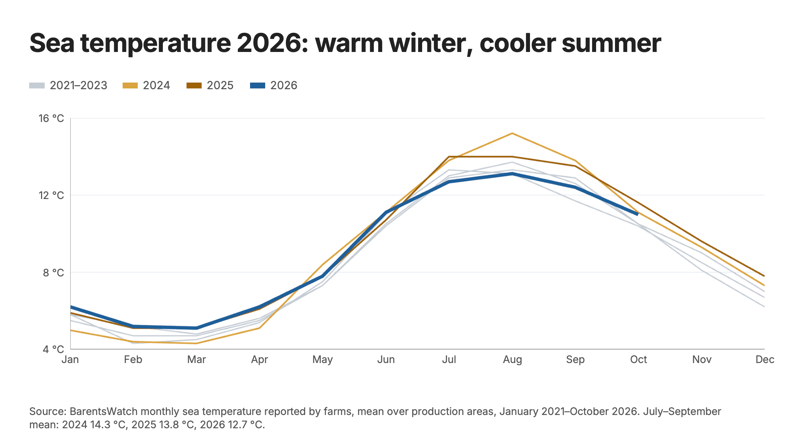
The 2026 temperature profile was unusual, with the warmest January and April of the six years we compared followed by a cooler late summer and fall. From August to October, sea temperatures averaged 12.3 °C, against 13.2 °C in 2025 and 13.5 °C in 2024.
Manolin built a fall lice pressure model to understand how much temperature shapes each season. It uses one data point per season since 2018, pairing average sea temperature from August to October with average adult female lice pressure over the same months. Fitted on the 2018 to 2025 seasons, the model shows each extra degree going with about 42% more adult female lice pressure, with a correlation of 0.76. When we tested the model by predicting each season from the others, it beat a plain average by about a fifth.
Because 2026 wasn't part of the data the model was built on, this season gives a useful check on how well it holds up. Based on its temperatures, the model expected average adult female lice pressure of 83 million through the fall, and the observed figure was 82 million. 2025 also landed close to its prediction, while 2024 came in about 15% above what its temperatures predicted.
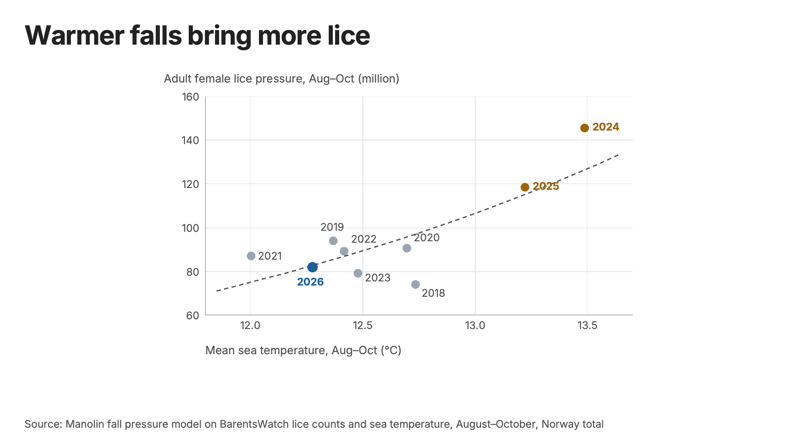
The model rests on nine seasons, so it describes a broad pattern, and temperature doesn't explain every season. 2018 came in well below its predicted level and 2021 above it, which means other factors play a part. The fit also comes from years when farms were treating actively, so its expectations already include the management effort of a normal season. That makes it most useful for reading each season in context and for estimating what the next one could bring if temperatures change.
Planning for a Warmer Fall
2026 shows what is possible when hard work on the farms lines up with a cooler fall, and the next step is planning for a season when the water is warmer. Using the same model, a fall as warm as 2025 (13.2 °C from August to October) would bring an expected 115 million adult female lice, about 41% more than 2026. A fall as warm as 2024 (13.5 °C) would bring around 126 million, or 54% more.
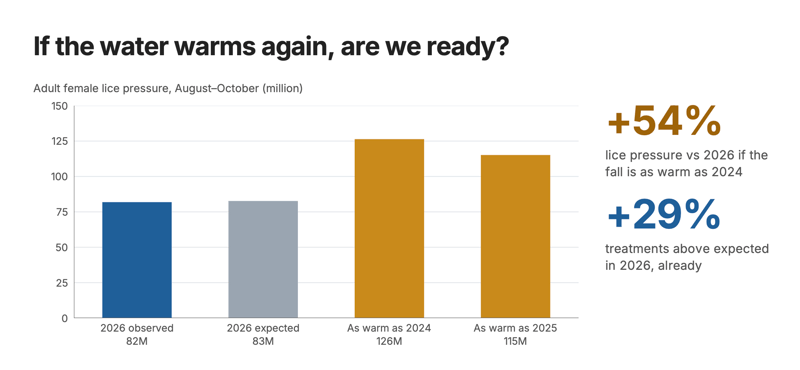
Pressure at that level would likely add to the load on mechanical delousing, which already carries most of the treatment work. Mechanical treatments are close to double their 2018 level, farms treated about 29% more this year than temperatures alone would predict, and bath and in-feed use are at their lowest since 2018. Farms are also adding prevention that doesn't appear in public treatment reports, such as lasers and submerged cages, so as practices change, the baseline for comparing one season with the next has to keep being updated.
In-feed treatments are one of the main preventive options in the toolbox today, and when used at the right time, they can take some pressure off mechanical capacity. If conditions turn warmer again, farms will want as many treatment options available as possible, and better forecasts help them see early when a preventive treatment should go in.
Putting More Context Into Treatment Planning
Manolin Explorer already supports treatment planning at site level, and the models behind this analysis give fish health teams more context for the decisions they make each week. Teams can see whether a cage's lice count is on track for its temperature and fish, compare treatment results against a baseline of comparable populations, and follow treatment and handling history through transfers. With that context in place, teams can plan treatments earlier and with a clearer sense of each option's likely outcome.